

Customer expectations have changed. People want quick answers, easy communication, and support whenever they need it. Waiting hours for a response to a simple question can quickly lead to frustration.
This is where AI chatbots are becoming useful for businesses.
AI-powered chatbots can answer customer questions, provide information, handle repetitive requests, and in some cases connect with business systems to complete simple tasks. They aren’t meant to replace every human support agent. Instead, they can work alongside customer-service teams to make support faster and more efficient.
Let’s look at how AI chatbots are changing customer support.
1. 24/7 Customer Support
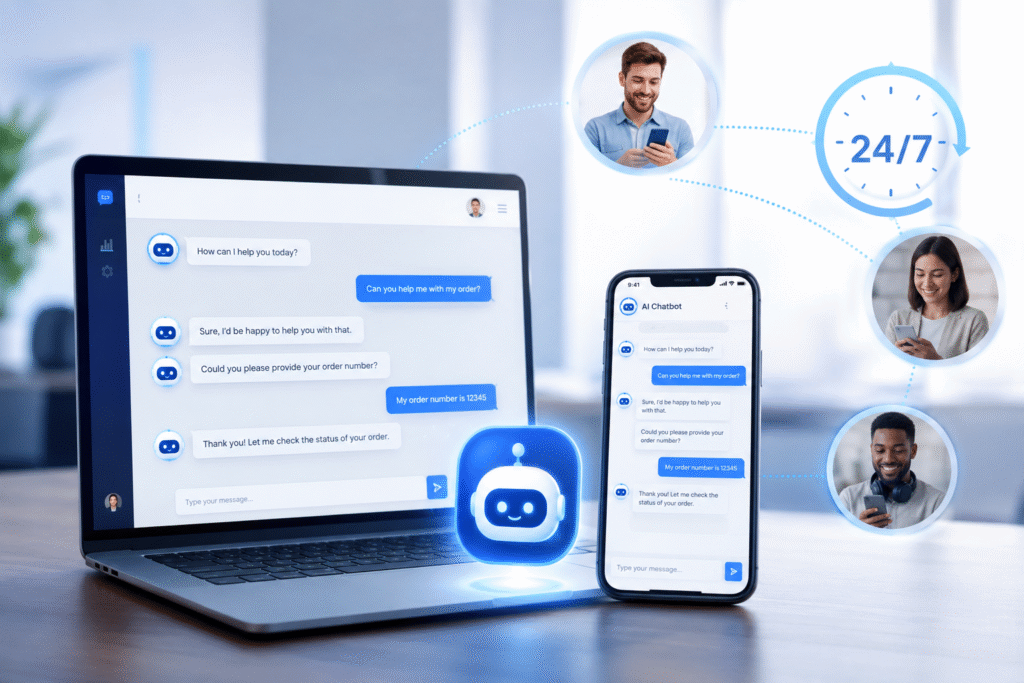
One of the biggest advantages of AI chatbots is that they can provide support around the clock.
Customers don’t always need help during normal business hours. Someone might have a question late at night, during a weekend, or on a holiday.
An AI chatbot can immediately respond to common questions such as:
- What are your business hours?
- How can I reset my password?
- Where is my order?
- What payment methods do you accept?
This gives customers immediate assistance while reducing the number of simple requests handled by human agents.
2. Faster Responses
Nobody likes waiting in a customer-support queue.
AI chatbots can respond to many routine questions within seconds. This can significantly reduce waiting times, especially when support teams are dealing with a large number of requests.
For example, instead of waiting for an agent to answer “How do I change my password?”, a chatbot can provide the instructions immediately.
This allows human agents to focus on more complicated customer problems.
3. Handling More Customers at Once
During busy periods, customer-service teams can become overwhelmed.
Sales events, product launches, service outages, and holidays can generate hundreds or thousands of customer questions.
A human team can only handle a limited number of conversations at once. AI chatbots can handle multiple conversations simultaneously.
This helps businesses manage high volumes of customer inquiries without making every customer wait for an available agent.

4. More Personalized Customer Experiences
Modern AI chatbots can do more than provide generic answers.
When securely connected to systems such as a CRM, e-commerce platform, or customer database, they can potentially provide personalized customer experiences.
For example, instead of saying:
“Your order is being processed.”
a chatbot could provide the customer’s current order status and expected delivery date.
Personalized support can make conversations more useful and reduce the effort customers need to find information themselves.
However, businesses must make data privacy and security a priority when connecting AI systems to customer information.
5. Less Repetitive Work for Employees
Customer-service teams often spend a large part of their day answering the same questions.
AI chatbots can take care of many repetitive requests, allowing employees to focus on issues that require human judgment, empathy, or deeper problem-solving. Businesses can also use automation to eliminate other repetitive tasks across their operations.
A simple model is:
Routine questions → AI chatbot
Complex issues → Human agent
This combination can make customer support more efficient without removing the human element.
6. Better Customer Insights
Customer conversations contain valuable information.
Businesses can analyze chatbot interactions to discover common problems and frequently asked questions.
For example, if customers repeatedly ask how to cancel a subscription, the company might need to make the cancellation process easier to find.
These insights can help businesses improve their:
- Products
- Websites
- Services
- Documentation
- Customer experience
So an AI chatbot can become more than a support tool—it can also help businesses understand their customers.
7. AI Doesn’t Replace Human Support
Despite the advantages of AI chatbots, they shouldn’t completely replace human customer-service teams.
Some situations require empathy, negotiation, critical thinking, or complex troubleshooting.
A good AI chatbot should recognize when it can’t solve a problem and provide a smooth transition to a human agent.
The best customer-support strategy isn’t necessarily AI versus humans.
It’s AI + humans.
How Businesses Can Get Started With AI Chatbots
Businesses don’t need to automate everything on day one.
A better approach is to start with common and straightforward customer questions.
Step 1: Identify repetitive questions
Look at your existing customer-support requests.
Step 2: Choose useful use cases
Start with FAQs, order tracking, appointment information, or basic troubleshooting.
Step 3: Connect reliable information
Make sure the chatbot uses accurate and updated business information.
Step 4: Add human escalation
Give customers an easy way to contact a human agent when necessary.
Step 5: Monitor and improve
Track customer satisfaction, resolution rates, and unanswered questions to improve the chatbot over time.
The Future of AI Customer Support
AI chatbots are moving beyond simply answering questions.
With the right integrations, they can increasingly help customers complete tasks, such as checking an order, scheduling an appointment, submitting a support request, or finding a product.
For businesses, the goal shouldn’t be to use AI simply because it’s popular.
The goal should be to use AI where it solves a real customer problem.
When implemented properly, AI chatbots can provide faster support, reduce repetitive work, handle larger volumes of requests, and create a better overall customer experience.