

Cloud migration has transformed from a technology trend into a business necessity. A few years ago, “the cloud” sounded like a buzzword reserved for tech companies and Silicon Valley startups. Today, it’s where a dentist’s office stores patient records, where a logistics company tracks its entire fleet, and where a five-person marketing agency runs its operations without a single physical server. The shift isn’t a trend anymore. It’s a business reality — and the businesses still clinging to on-premise infrastructure are starting to feel the gap.
The Real Reason Businesses Are Going Cloud-First
It’s tempting to say it’s all about cost savings. That’s part of it. But the deeper driver is flexibility — the ability to scale up when demand spikes, scale down when it doesn’t, and deploy new tools without waiting weeks for hardware procurement and IT setup. Traditional infrastructure forces a choice: overpay for capacity you might not use, or underbuild and scramble when you need more. The cloud eliminates that dilemma. You pay for what you use, when you use it.
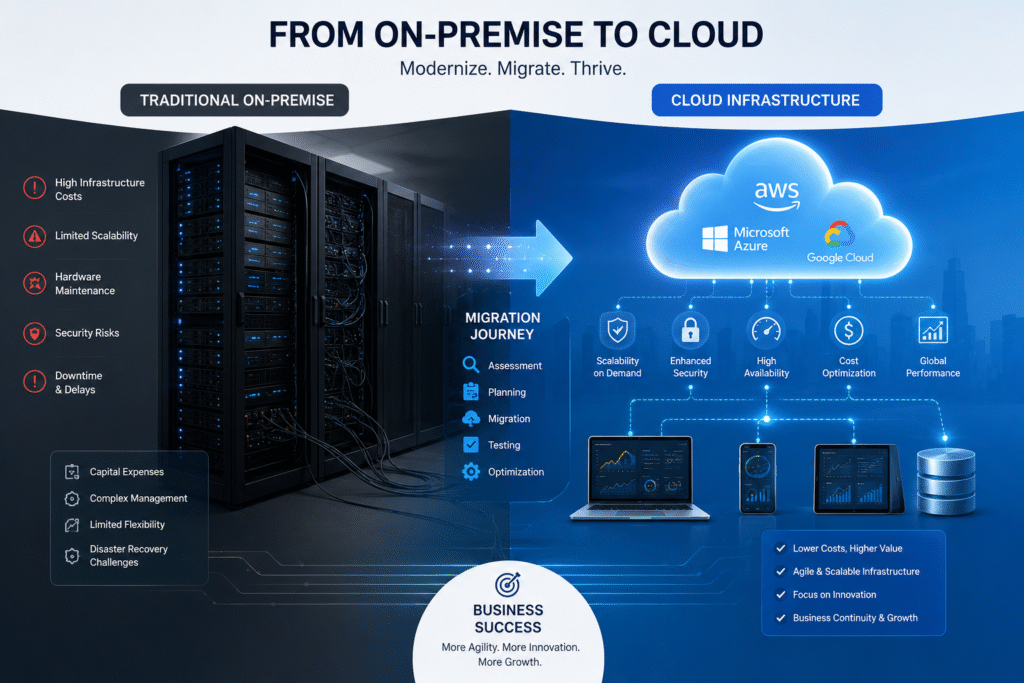
That model changes how businesses plan, budget, and grow.
Cost Efficiency That Goes Beyond the Server Bill
Owning and maintaining physical servers is expensive in ways that don’t always show up on a single line item. There’s the hardware itself, then cooling systems, power costs, IT staff to manage it, and the replacement cycle every few years. It adds up fast. Cloud migration shifts that spend to a predictable operating expense. No surprise hardware failures. No emergency replacement costs. No dedicated data center staff. But the savings go deeper than infrastructure. Cloud-based tools reduce software licensing complexity, cut down on redundant systems across departments, and eliminate entire categories of IT overhead. A mid-size company that migrates thoughtfully often finds its total technology spend drops — while its capabilities go up.
Remote Work Made It Non-Negotiable
The pandemic accelerated cloud migration by years, not months. When offices closed overnight, businesses with cloud-based operations kept running. Their teams accessed files, communicated, collaborated, and served customers from home because everything lived in the cloud — not in a server room no one could get to. Businesses still running on local networks scrambled. VPN capacity collapsed. File sharing became a patchwork of workarounds. Productivity fell off a cliff. That experience permanently changed how executives think about infrastructure. The question stopped being “do we need the cloud?” and became “how fast can we get there?” Even as offices reopened, hybrid work stuck. And hybrid work runs on cloud infrastructure. It’s that simple.

Security: The Objection That’s Losing Ground
For years, the biggest concern around cloud migration was security. “We can’t put sensitive data somewhere we don’t control.” It was a fair concern — in 2012. Today, major cloud providers like AWS, Google Cloud, and Microsoft Azure invest more in security infrastructure annually than most businesses spend on their entire IT budget. Industry best practices published by the Cloud Security Alliance (CSA) also help organizations strengthen cloud security and governance. They employ dedicated security teams, maintain compliance certifications across dozens of regulatory frameworks (SOC 2, ISO 27001, HIPAA, GDPR), and update their defenses constantly. The honest truth? Most on-premise environments are less secure than a well-configured cloud setup, not more. The breach risk doesn’t disappear in the cloud, but the tools to manage it are significantly more powerful.

Speed to Market Gets Faster
Here’s something that doesn’t get talked about enough: the cloud doesn’t just reduce costs — it compresses timelines. Want to launch a new product? Spin up a test environment in minutes. Need to run a global marketing campaign? Deploy infrastructure across regions without touching physical hardware. Building a new internal tool? Use cloud-native services to skip months of backend development. Businesses that operate in the cloud move faster than those that don’t. When your competitors can test, iterate, and launch in weeks while you’re still provisioning servers, that gap becomes a competitive disadvantage you can feel.
The Data Advantage
Every business today is generating enormous amounts of data — from customer behavior
and sales patterns to operational metrics and supply chain signals. The cloud makes that
data useful.
Cloud-native analytics tools, AI services, and machine learning platforms integrate directly
with your data storage. You don’t need a separate data warehouse, a specialized
engineering team, or a six-figure analytics platform to start pulling insights from what you
already have.
A retail business can analyze purchasing trends in real time. A logistics company can
predict delivery delays before they happen. A SaaS startup can track user behavior to
reduce churn. None of that is easy — or cheap — with traditional infrastructure. In the
cloud, it’s increasingly accessible even for mid-market businesses.

What’s Holding Some Businesses Back
Not every business has made the leap, and the hesitation usually comes down to a few familiar concerns.
Legacy systemare a genuine obstacle. When core business processes run on software from 2003 that wasn’t designed to connect with anything modern, migration gets complicated. It requires planning, sometimes custom integration work, and a realistic timeline — not a weekend project.
Change resistance from internal teams is just as common. IT departments that built their careers around managing on-premise infrastructure don’t always champion a model that restructures their role. Bringing people along — not just announcing a migration — makes a meaningful difference in how smoothly it goes.
Poorly planned migrations have also burned some businesses. Lifting and shifting everything without rearchitecting for the cloud often leads to higher costs, not lower ones. Cloud migration done badly is expensive. Done strategically, it pays for itself.
The Businesses That Move Thoughtfully Win
There’s a version of cloud migration that’s reactive — companies scrambling to modernize because they’re falling behind. And there’s a version that’s strategic — businesses that map their workloads, prioritize the right systems to move first, and build toward a cloud architecture that supports where they’re going, not just where they are. The second group consistently outperforms the first. Following guidance from the NIST Cloud Computing Program can help businesses plan secure and scalable cloud migration strategies.
Conclusion: The Cloud Isn’t the Future. It’s Now.
Cloud migration is no longer just a technology trend—it’s a strategic business decision that delivers scalability, security, and long-term growth. They’re doing it because it works — faster deployment, lower overhead, better security, and the ability to use data in ways that on-premise infrastructure simply can’t match. If your business is still on the fence, the question worth asking isn’t “should we move to the cloud?” It’s “what’s it costing us not to?” Ready to build a cloud strategy that actually fits your business? Our team helps companies navigate migration, choose the right platforms, and get the most out of every dollar they move to the cloud. Let’s talk.
Frequently Asked Questions
How long does a cloud migration typically take?
It varies widely based on the size of your infrastructure and the complexity of your systems. A small business moving email and file storage might be done in a few weeks. A mid-size company migrating core business applications, databases, and legacy systems could be looking at six to eighteen months. The key is phasing the migration intelligently — move the easy, low-risk workloads first, learn from that process, then tackle the complex ones.
Is the cloud really more secure than on-premise infrastructure?
For most businesses, yes — but it depends on how it’s configured. Cloud providers offer enterprise-grade security tools, automatic patching, and compliance frameworks that would cost most businesses millions to replicate on their own. The risk usually comes from misconfiguration, not the cloud itself. Working with a qualified cloud architect during migration significantly reduces that risk.
What’s the difference between public, private, and hybrid cloud?
A public cloud uses shared infrastructure from a provider like AWS, Azure, or Google Cloud. A private cloud is a dedicated environment used solely by your organization — either on-premise or hosted. A hybrid cloud combines both, letting businesses keep sensitive data on private infrastructure while running other workloads publicly. Most enterprises land on hybrid as the practical middle ground.
Will moving to the cloud reduce my IT team’s workload?
It shifts the workload more than it reduces it. Your IT team spends less time managing hardware and more time managing cloud services, security configurations, and cost optimization. Many businesses find their IT function becomes more strategic and less reactive after migration — which is often a win for both the team and the business.
What should we migrate to the cloud first?
Start with workloads that are low-risk, high-impact, and relatively self-contained — email systems, file storage, collaboration tools, and backup infrastructure are common first steps. Avoid starting with your most critical, complex, or heavily integrated systems. Build confidence and process with simpler migrations before tackling anything mission-critical.